
No products in the cart.
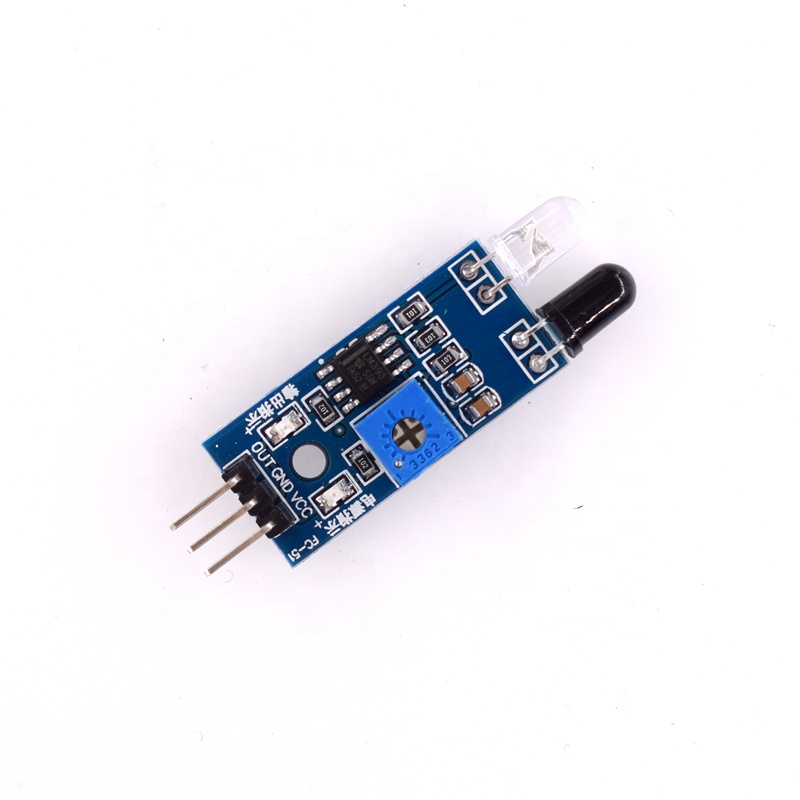
Obstacle Infrared Sensor module
In Stock
2,500RWF
In Stock
The Obstacle Infrared Sensor module is an electronic device that detects the presence of an obstacle by emitting and detecting infrared light. It consists of an infrared transmitter and receiver that are mounted on the same PCB board. When an object is present in the range of the module, the infrared beam is reflected back to the receiver, which triggers the sensor module to send a signal to the microcontroller or processor to take the necessary action. It is commonly used in robotics, automation systems, and security systems to detect obstacles and avoid collisions.
Description
An Obstacle Infrared Sensor module is an electronic device that is designed to detect the presence of an obstacle in its range by emitting and detecting infrared light. It is commonly used in robotics, automation systems, and security systems. The module typically consists of an infrared transmitter and receiver that are mounted on the same PCB board.
The infrared transmitter emits an infrared beam that is then reflected back to the receiver by any object that comes in its range. If an object is present, the infrared beam is reflected back to the receiver, which triggers the sensor module to send a signal to the microcontroller or processor to take the necessary action. The range of the sensor can vary depending on the model, but typically ranges from a few centimeters up to several meters.
The Obstacle Infrared Sensor module can be configured to work in different modes, such as obstacle detection, distance measurement, or line tracking. It is a reliable and cost-effective solution for detecting obstacles and avoiding collisions in robotics and automation applications. It is also commonly used in security systems to trigger alarms when someone or something enters a specific area.
- Infrared Transmitter: The module typically uses an IR LED as the infrared transmitter. The operating wavelength of the LED is typically around 940 nm.
- Infrared Receiver: The module typically uses a photodiode or phototransistor as the infrared receiver. The receiver has a built-in amplifier that amplifies the weak infrared signal received from the transmitter.
- Operating current: The operating current of the module is typically in the range of 20 to 50 mA.
- Output voltage: The output voltage of the module is typically around 3.3V or 5V, depending on the operating voltage of the module.
- Output signal: The module provides a digital output signal that indicates the presence or absence of an obstacle. The signal is typically high (logic 1) when no obstacle is detected and low (logic 0) when an obstacle is detected.
- Detection range: The detection range of the module can vary depending on the model, but typically ranges from a few centimeters up to several meters.
- Detection angle: The detection angle of the module can vary depending on the model, but typically ranges from 30 to 60 degrees.
- Response time: The response time of the module is typically in the range of a few microseconds, which makes it suitable for fast-moving objects.
- Operating temperature: The module can operate in a wide temperature range, typically from -10°C to +50°C.
- Dimensions: The dimensions of the module can vary depending on the model, but typically range from 20 mm to 40 mm in length and width. The height of the module is typically around 10 mm.


Reviews
There are no reviews yet.